14 Sept 2026
Can You Buy a Humanoid Robot for Your Home? Models, Delivery and Real Costs
Some humanoid robots are reportedly on sale, but hardware availability does not guarantee useful household help. Compare reported prices, delivery claims and the checks to make before paying.
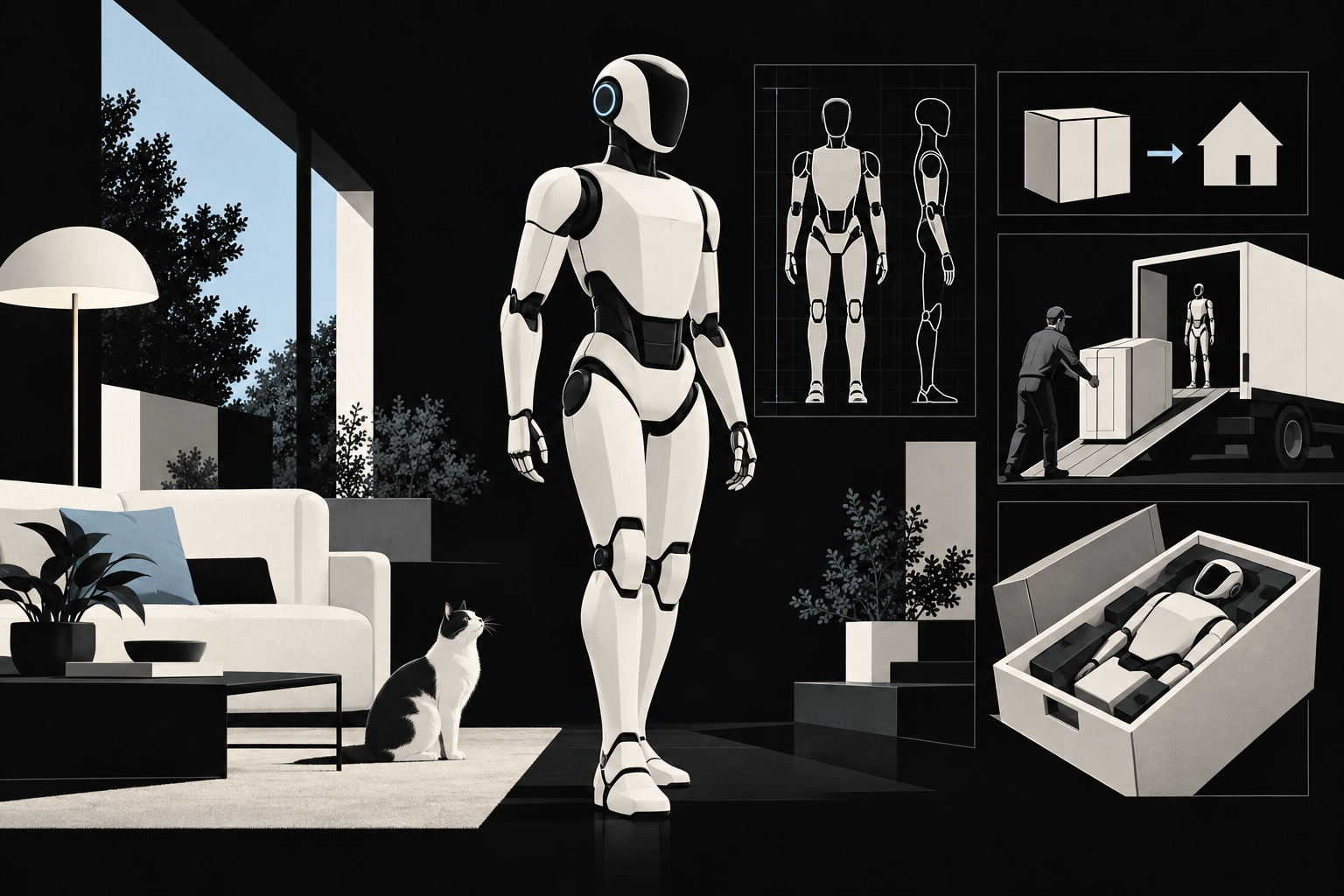
Yes—some humanoid robots are reported to be available to buy, but buying one is not the same as getting a dependable household helper. Humanoid Press reports Unitree G1 shipping worldwide from $16,000 and 1X NEO offered at $20,000 or $499 per month, with US deliveries underway in 2026. Those reports do not establish stock, delivery eligibility or contract terms for your address.
For a home buyer, the first distinction is between a robotics platform for experimentation and a product intended to perform domestic tasks. G1 is relevant to the former; NEO is explicitly aimed at the latter.
This guide uses 2026 reporting, not live stock checks. The evidence does not establish a universally available, independently tested household helper.
Key takeaway: Investigate G1 if you want a robotics project, and NEO if you want domestic assistance. Before paying, verify the exact configuration, household capabilities, delivery commitment and continuing service costs—not just the headline price.
Which humanoid robots are realistic buying candidates?
The table separates reported offers from pricing ambitions and production plans. Dollar figures are reproduced as reported; they are not confirmed UK delivered prices.
| Humanoid robot | Reported price | What the reporting establishes | Implication for a home buyer |
|---|---|---|---|
| Unitree G1 | From $16,000 | Humanoid Press reports worldwide shipping and a research and education focus | Investigate as a development platform, not a guaranteed chore service |
| 1X NEO | $20,000 or $499/month | Humanoid Press reports a home-focused offer and US deliveries underway in 2026 | Verify regional availability, subscription terms and task performance |
| Tesla Optimus Gen 3 | Target below $30,000 | Humanoid Press describes a pricing ambition for factory and home use | Not an established household checkout price |
| Figure 03 | Not stated | Reporting describes industrial pilots and expanding home applications | Demonstrations do not establish a residential purchase route |
| Agility Robotics Digit | Not stated | Reporting describes warehouse work and an automotive logistics agreement | Commercial deployment is not evidence of a household offer |
| XPeng IRON | Not stated | Electrek reports production and delivery targets | Do not confuse planned output with a home delivery commitment |
Most pricing and availability details here come from Humanoid Press’s roundups. They are useful leads, but their rankings are not substitutes for seller documentation or independent household testing.
Unitree G1: consider it as a robotics project
The Unitree G1 is the clearest reported hardware-buying option in this comparison. Humanoid Press places it in research and education, quotes a starting price of $16,000 and reports ROS2 compatibility.
That makes G1 worth investigating if programming and experimentation are the purpose of the purchase. It does not establish that the entry-priced package will independently sort laundry, clear a kitchen or fetch whatever you request.
Before ordering, ask the seller to identify:
- The exact hardware configuration, including hands and batteries.
- The software access and development tools included.
- Which behaviours work on delivery, without additional programming.
- Which advertised capabilities require optional hardware or software.
- Whether support covers private residential use.
Treat “from” as an instruction to obtain a configuration-specific quotation. Do not assume the least expensive package includes everything shown in a demonstration.
Buying judgement: G1 merits investigation when development work is part of the attraction. Do not justify its price through household labour savings that have not been demonstrated and agreed.
NEO: the home-focused option needs a contract check
The 1X NEO is explicitly positioned for domestic use. Humanoid Press’s August 2026 roundup describes laundry folding, room tidying and conversation, alongside a $20,000 purchase price and $499 monthly subscription option.
The same roundup reports US deliveries underway in 2026. That is not confirmation of immediate availability, a subscription in every country or a delivery slot for a particular household. The cited reporting does not establish a UK delivery date.
The most important question is what domestic assistance the offer actually promises. Ask the seller to separate functions available on delivery from demonstrations, planned capabilities and anything requiring human intervention.
Then obtain written answers to the commercial questions:
- Is the offer available to a private household at your address?
- Is payment for ownership, a subscription, a reservation or participation in a trial?
- What are the delivery window and cancellation rights?
- Which services are included, and which can incur additional charges?
- What happens if the robot cannot perform the agreed tasks?
Do not assume either that remote human assistance is required or that it is absent: establish the operating arrangement directly.
Buying judgement: NEO belongs on a domestic shortlist. Its home-focused positioning should lead to more specific questions about household performance, not fewer.
Optimus, Figure 03 and IRON: distinguish ambition from an offer
Tesla Optimus Gen 3
Humanoid Press describes Tesla Optimus Gen 3 as targeting factory and home use, with sub-$30,000 pricing as an ambition. That figure should not be presented as a confirmed retail price.
The cited overview does not supply a household order contract, deposit policy or delivery date. Keep Optimus on a watchlist if its intended uses interest you, but do not budget around receiving one on an assumed schedule.
Figure 03
Humanoid Press describes Figure 03’s industrial pilots and expansion towards home applications. There is also a concrete household demonstration claim: in a video description dated 8 May 2026, Figure says two F.03 robots cleaned a room and made a bed in under two minutes, fully autonomously.
That is a manufacturer’s description of a demonstration, not an independent household test or a retail service guarantee. It does not answer how the system performs in an unfamiliar bedroom, how often it needs intervention or whether a consumer can order it.
XPeng IRON and commercial alternatives
Electrek’s 24 August 2026 report says XPeng is targeting IRON mass production by the end of 2026, initially for its own stores and campuses, followed by deliveries in China and overseas markets in 2027.
These are reported plans, not commitments to supply private homes. Likewise, Digit’s reported logistics deployments do not establish residential availability. A commercial customer using a humanoid robot successfully is relevant progress, but it is not a home purchase offer.
Delivery: get an offer tied to your address
Ask for a written quotation naming the model, generation, configuration and destination. A worldwide-shipping statement does not resolve the practical details of your order.
Your offer should distinguish a dispatch estimate from a delivery commitment. If the date depends on production milestones or programme eligibility, ask the seller to state those conditions explicitly.
Before making a payment, confirm:
- Eligibility: will the seller supply and support a private residential customer?
- Destination: are sales, repairs and returns supported in your country?
- Contents: which accessories, software permissions and services are included?
- Payment: what does an initial payment reserve, and when is the balance due?
- Delays: what refund or cancellation rights apply if shipment slips?
- Acceptance: how will you check that the delivered system meets the agreed specification?
For a trial or pilot, establish who owns the hardware and who is responsible for damage, collection and ongoing support. Do not assume a programme invitation carries the same rights as an outright purchase.
Real costs: compare complete offers, not headline figures
The cited evidence supports individual advertised or reported prices, but not a defensible all-in household ownership total. It does not provide comparable shipping, tax, maintenance, software and assistance charges across these models.
Request a quote built around this framework:
Delivered hardware + applicable taxes and shipping + required setup + contracted recurring services + maintenance provision.
This is a quotation checklist, not a claim that every seller charges for every category.
Hardware and delivery: specify the configuration, freight arrangements, import responsibility and any applicable VAT or duties. Ask which quoted amounts are fixed and which remain estimates.
Setup and software: establish whether installation, training or a home assessment is required. Identify included capabilities and any that depend on a continuing licence or service.
Support and repairs: request warranty exclusions, service locations, replacement-part terms and responsibility for transport. Ask what support remains available if a subscription ends.
Assistance and cancellation: if human assistance is offered, establish whether it is included, capped or separately charged. Check minimum terms, return conditions and termination fees.
For NEO’s reported $499 monthly option, the minimum term, upfront payment, ownership position and included support are essential to comparison with the $20,000 purchase figure. The monthly amount alone cannot tell you which route costs less.
For G1, compare the complete configuration you need with the reported $16,000 starting price. A cheaper package is not better value if it omits capabilities central to your project.
Test the household result, not an isolated movement
Choose a specific job before choosing a humanoid robot. Write down the starting conditions, the finished result and the assistance you are willing to provide.
For laundry, define whether the job means collecting clothes, carrying a basket, loading a machine, unloading it or folding particular items. “Does laundry” is too broad to serve as an acceptance criterion.
Ask the supplier to demonstrate the complete workflow under agreed, controlled conditions. Request disclosure of environmental preparation, remote operation and manual intervention, and ask to see unsuccessful attempts as well as successful ones.
A useful assessment should answer:
- Can the task be repeated with your intended objects and layout?
- What preparation must a person perform first?
- What happens when an object is misplaced or the route is blocked?
- Does the system stop, ask for help or attempt recovery?
- How much supervision and intervention does completion require?
Do not assess only the easiest movement. For fetching, for example, agree what happens from the initial request through identification, collection and safe handover—including what the robot should do if it cannot find the item.
If the seller cannot demonstrate your intended job or define its limitations, treat that capability as unresolved rather than pricing it into the purchase.
Safety and privacy belong in the buying decision
Request model-specific residential operating instructions before arranging a home trial. Do not infer permission for unattended use from a soft exterior, a balance demonstration or a general safety description.
Ask for written guidance on children, pets, stairs, fragile objects, charging and required operating space. Establish how to stop the robot and what happens after loss of power, connectivity or any assistance service.
Keep the initial assessment within the supplier’s documented conditions. A home trial should not be an improvised stress test around people or animals.
Privacy needs equally explicit answers. Ask whether the proposed configuration uses cameras or microphones, what information leaves the home and which functions depend on external processing.
If remote personnel can access the system, establish:
- Who can see, hear or control what.
- Whether access requires household approval.
- Whether sessions are recorded and access is logged.
- How data is retained, deleted and used.
- What functionality remains if you decline access.
These are due-diligence questions, not allegations about any named product. Include other household members in the decision rather than treating consent as solely the purchaser’s concern.
Should you buy now or wait?
Investigate G1 if you want a development platform and can confirm the configuration, support and delivery terms. Judge it against your robotics project, not assumed domestic savings.
Investigate NEO if household assistance is the goal and you can obtain satisfactory task demonstrations, privacy terms and a written delivery commitment. Verify the reported purchase and subscription offers directly.
Wait for a documented offer if Optimus, Figure 03 or IRON is your preferred model. The cited material does not establish their household retail terms.
If your requirement is dependable, unattended chore completion, do not buy until the seller can demonstrate and contract for that requirement. The decisive question is whether you can purchase the household result and support you need—not simply the robot body.
Sources and evidence limits
The following sources support the reported prices, positioning and plans above. The Humanoid Press roundups are secondary reporting; their superlatives and readiness scores are not treated here as independently verified results. No binding seller contracts or independent household test reports were supplied.
- Humanoid Press: company overview for 2026 — Research and education positioning for G1, Optimus pricing ambitions, and company application areas.
- Humanoid Press: robot strengths roundup, August 2026 — Reported G1 shipping and starting price, NEO pricing and US delivery claims, and Digit’s commercial deployment context.
- Figure: Helix 02 Bedroom Tidy — Captured video description dated 8 May 2026; used only for Figure’s household demonstration claim.
- Electrek: XPeng financing and IRON production plans — Report dated 24 August 2026, describing production and delivery targets rather than confirmed household availability.
Robots mentioned
The Dispatch, once a week
The humanoid robot stories that mattered this week — launches, deployments, prices and funding, each read at the source. Read past issues.